A good fascia sign layout puts your business name first, sizes the logo to the fascia height, and leaves enough clear space for the sign to read from across the street. What you can fit depends on three things: the height and length of your fascia, how much text your brand carries, and how far away your customers will see it from.
At Manchester Signs Centre, we help businesses plan fascia signage that suits their shopfront dimensions, branding and customer visibility. Whether you are installing new fascia signs or updating an existing shop front sign, the right layout can help your premises stand out, attract attention and create a lasting impression.
Shallow fascias and very long shopfronts are the two hardest cases. This guide shows you how to plan for both, so your brand identity stays readable on the high street, whether you are on Deansgate, Market Street or a retail park.
What Should Go on a Fascia Signage and in What Order?
Every fascia sign is a small hierarchy. Decide the order of importance before you think about materials or lighting.
-
Business name: the largest element, because it is what customers search for and remember.
-
Logo: the visual anchor, usually placed at the left or centre of the fascia.
-
Tagline or descriptor: sometimes a tagline, such as “Coffee and Bakery”, in smaller type. If it will not stay legible, drop it from the fascia and use window graphics instead.
-
Contact details: rarely needed on the fascia. Keep them for the window or door.
Keep the wording short enough for customers to understand within a few seconds. As a practical guideline, aim for no more than around 7 to 10 words, including a short business description if needed. Leave negative space around the text and logo instead of filling every part of the fascia. This improves visibility and helps the most important information stand out.
A well designed fascia sign carries one clear message. Every extra line of text shrinks the rest, so cut anything that does not help a passer-by identify you in two seconds.
How Does Fascia Sign Layout Help Attract Customers?
People walking or driving past a business often have only a few seconds to notice its signage. This makes effective fascia signage particularly important for premises facing busy streets with regular foot and vehicle traffic.
A clear layout helps new customers identify your store or service without having to stop and read several lines of information. High quality fascia signage also makes a stronger first impression when its colours, lettering and proportions match your business identity.
Unlike temporary promotions, a well-designed fascia sign represents your business 24 hours a day, even when the premises are closed. Appropriate illumination can also improve its visibility after dark. Although a sign cannot guarantee increased footfall, clear branding makes it easier for potential customers to notice and recognise your business.
How Do You Fit a Logo on a Fascia Sign With the Right Proportions?
Most logos are designed for a square or near-square space, while most fascias are a long horizontal band. That mismatch is the root of most shop sign logo proportions problems.
There are three common ways to resolve it:
-
Horizontal lockup: place the symbol beside the business name on one line. This suits most shopfronts and is the safest default.
-
Icon plus wordmark split: put the symbol at one end and the name at the centre, balancing a long fascia.
-
Wordmark only: use the typed name and drop a complex symbol that would be too small to read.
As a working rule, keep letters and symbols at roughly 60 to 70% of the fascia height, leaving even margins above and below. Tight margins make a sign feel cramped, and the text looks as if it is spilling out of the panel.
Always ask your designer for a horizontal version of your business name logo. At Manchester Signs Centre, our team can adapt a stacked logo at the free design stage so the proportions of fascia signage stay true to your brand.
What Is the Best Signage for Shallow Shop Fascias?
When the fascia is shallow, often 300 to 450mm high, the layout has to work harder. Height is the constraint, so use length instead.
-
Single line only: stacking two lines of text on a shallow fascia cuts letter height in half and hurts visibility.
-
Short names win: shorten “The Manchester Coffee Roasting Company” to “Manchester Coffee Roasters” if your brand guidelines allow it.
-
Bold, simple type: medium or bold sans-serif letterforms hold up better than thin scripts at small heights.
-
Strong contrast: light letters on a dark panel, or the reverse, improve readability in low light.
Letter height also decides viewing distance. As a guide, every 25mm of letter height reads comfortably from around 8 to 10 metres. A 200mm letter therefore works for pedestrians across a typical street, but may struggle for vehicle traffic passing at speed.
If the fascia cannot carry everything, move secondary information elsewhere. A pavement sign can carry offers and menus at eye level, leaving the fascia to do one job well.
How Do You Design a Long Shopfront Sign Without Losing Impact?
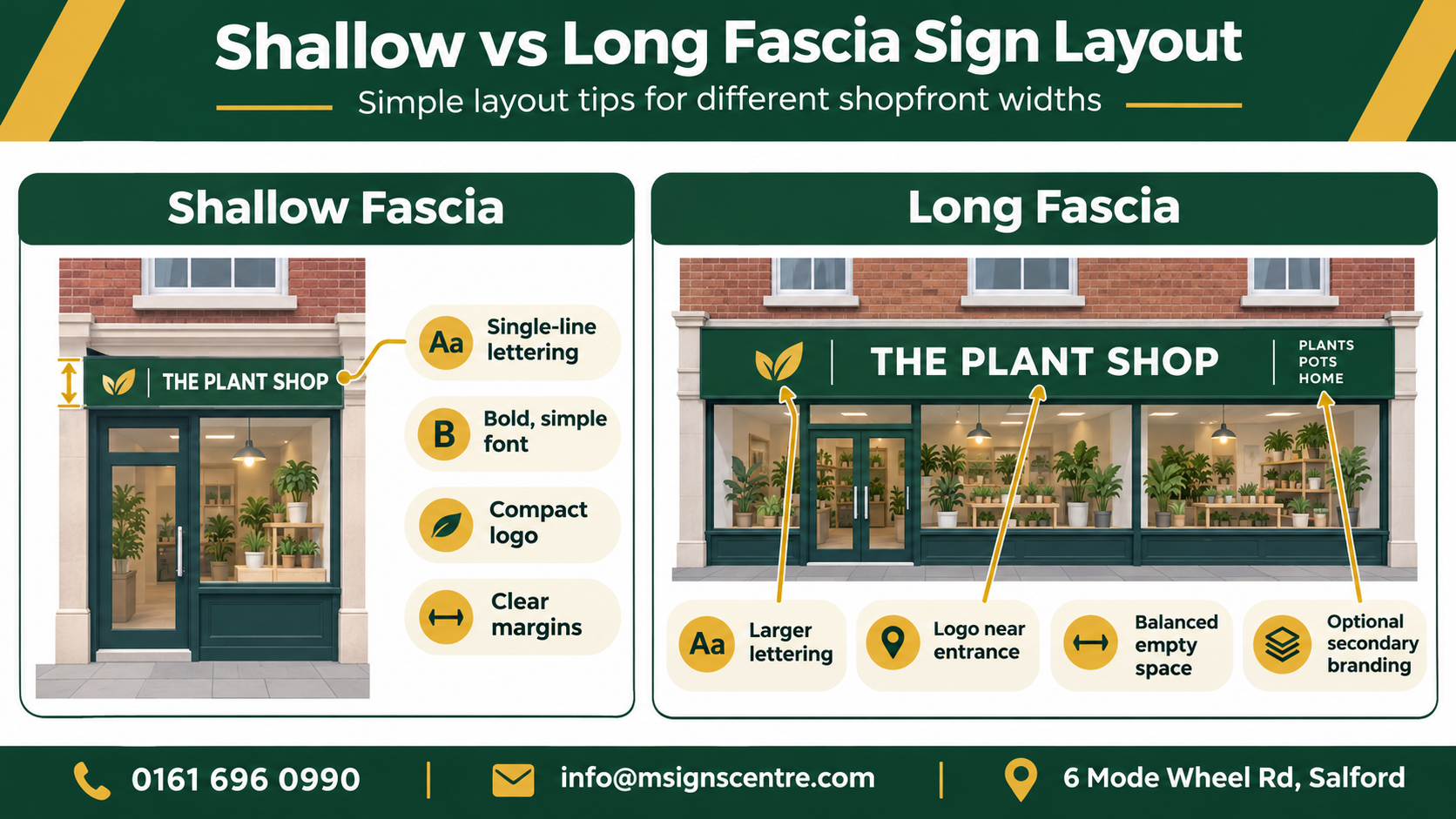
A long fascia over a wide frontage creates the opposite problem. A small logo in the middle looks lost, with empty panel either side.
Try one of these approaches:
-
Scale up the lettering: let the business name fill 60 to 70% of the length, centred or left-aligned with the entrance.
-
Split the fascia: divide a very long panel into two or three sections aligned with the shop windows, with the logo above the entrance.
-
Repeat the brand: use the name on the main fascia and the logo alone on a secondary panel above a side window.
-
Add a projecting sign: projecting signs catch the eye of people walking along the pavement, which a flat fascia cannot do.
Align the sign with the architecture. Centre the main message over the entrance, and keep any fascia breaks in line with the pilasters or window mullions.
Which Materials and Lighting Suit Your Fascia Layout?
The choice of materials affects the appearance, depth and durability of your fascia signage. Different sign types suit different layouts, depending on the available space, desired finish and budget.
-
Aluminium composite panels with vinyl graphics: flat, weather resistant and cost-effective. Suitable for most retail units, with a typical life of 7 to 10 years outdoors.
-
Flat-cut acrylic letters: Individual acrylic letters mounted onto the fascia create a neat, slightly raised three-dimensional appearance without the depth of fully built-up lettering.
-
Built-up 3D letters: These provide greater depth and a more prominent display. They can be illuminated or non-illuminated depending on the design and installation requirements.
-
Dimensional lettering: Individual letters mounted on the fascia or a backing panel add depth and a premium look.
-
Illuminated fascia signs: Face lit letters or halo illumination keep your name visible in low light, and are suitable for businesses that need better visibility after dark. Lighting can be incorporated into letters, fascia trays or other appropriate sign constructions.
Bespoke fascia signage can combine a simple ACM background with raised acrylic lettering to achieve a clean, professional result. The best combination depends on your branding, the dimensions of the premises and the viewing distance.
For shallow fascias, a push-through design can work well because the lettering glows while the panel stays slim. See our push through illuminated fascia trays for how this looks in practice.
Do Planning Rules Affect Your Fascia Sign Layout?
Yes, because size, height and lighting can all change whether you need consent. The Planning Portal explains that many traditional, non-illuminated fascia signs are likely to have deemed consent, subject to conditions such as size.
Check these points before you finalise artwork:
-
Illumination: most lit signs need express consent from the local planning authority unless they meet deemed consent limits.
-
Character height: the Town and Country Planning (Control of Advertisements) (England) Regulations 2007 set limits on lettering size and height above ground. The regulations on legislation.gov.uk cap characters at 0.75 metre in some classes.
-
Conservation areas and listed buildings: stricter rules apply, and listed buildings need separate listed building consent.
-
Landlord approval: your lease may restrict materials, colours or position, especially in retail parks and managed centres.
Rules differ in Scotland, Wales and Northern Ireland, so check with your local planning authority before you order.
How Do You Plan a Fascia Layout Step by Step?
-
Measure the fascia: record height, length, depth of any cornice, and distance from the pavement.
-
Gather brand files: request vector logos in horizontal and stacked versions, plus your brand colours.
-
Set the hierarchy: business name first, logo second, tagline only if space allows.
-
Test at distance: print the mock-up and view it from 10 metres, or on a phone screen from across a room.
-
Check planning and lease: confirm consent requirements before manufacture.
-
Book a site survey: exact measurements and fixing checks avoid costly remakes.
Manchester Signs Centre offers free site visits, so you do not need to take these measurements alone. Our Greater Manchester team can check the substrate, the fixing points and the viewing distance on site.
How Do You Plan Fascia Signage Within Your Budget?
New fascia signs can vary in cost depending on their size, materials, lettering depth, lighting and installation requirements. A simple ACM panel may suit businesses working with a smaller budget, while raised acrylic letters or illuminated designs may involve additional costs.
Bespoke fascia signage does not have to include every available feature. Focus your budget on clear lettering, strong contrast and a quality fascia finish that suits your building.
When comparing quotes for new fascia signs, check what is included in the design, manufacture, electrical work and installation. Access to the fitting location can also affect the overall cost, particularly for signs installed at height.

Which Fascia Layout Works Best for Your Sector?
-
Retail: prioritise the business name and logo, and use window graphics for offers. Illuminated lettering helps in winter evenings.
-
Hospitality: keep the type bold and add a projecting sign so people spot you from either direction along the street.
-
Offices and clinics: a clean horizontal band with a discreet logo suits a professional tone and often passes planning more easily.
-
Retail chains and multiple locations: standardise the layout so every site looks consistent, but adapt the length to each fascia.
If you are replacing old signage, photograph the existing sign and note what customers already recognise. Keeping familiar colours and placement preserves the recognition you have built while you refresh the quality of the finish.
Planning and Fitting Your Fascia Layout With Manchester Signs Centre
At Manchester Sign Centre, we design, make and install signs in-house, so layout decisions move from drawing to fitting without hand-offs.
-
Shop Front and Fascia Signs: durable fascia and tray signs, with layouts drawn to your exact fascia dimensions so the logo and business name stay readable.
-
Light Boxes: illuminated panels that keep a shallow fascia visible after dark without adding bulk.
-
Outdoor Signs: weatherproof signage for secondary positions such as side walls and entrances.
FAQs About Fascia Sign Layout
How tall should the lettering be on a fascia sign?
Aim for letters at around 60 to 70% of the fascia height. This leaves even margins and keeps the sign readable without looking crowded.
Can I fit a long business name on a shallow fascia?
Yes, if you use a single line and a simple, bold typeface. If it still looks cramped, shorten the name on the sign or move extra wording to your windows.
Should the logo or the business name be larger?
The business name should usually lead, because customers read it first. The logo works best as a supporting anchor of similar height.
Do I need planning permission to change my fascia sign?
It depends on size, height and lighting. Many non-illuminated fascia signs have deemed consent, but lit signs, conservation areas and listed buildings often need approval.
How long do fascia signs last?
Aluminium composite fascia signs with quality vinyl graphics typically last 7 to 10 years outdoors. Lifespan depends on exposure, cleaning and the finish used. Our outdoor shop sign maintenance advice covers how to extend it.
Is a projecting sign better than a bigger fascia?
Not necessarily, but it complements one. A projecting sign is seen along the pavement, while the fascia is seen head-on.
Get Your Fascia Layout Right First Time
Our complete guide to fascia tray signs is a good starting point if you want to compare construction options. When you are ready to move forward, our fascia and tray signs are designed for your exact fascia size, with free design and no-obligation quotes. If you want a lit option, our light boxes keep your name clear in low light.
We also offer free site visits, professional installation across the UK and a Salford workshop. Speak to the Manchester Signs Centre team today through our contact page to discuss your requirements.