Warehouses are fast-paced, high-risk environments where clear communication is essential. Forklift movements, pedestrian routes, storage zones, and emergency exits all rely on visual guidance to keep operations running safely and efficiently. Hence, warehouse signs play a crucial role. When chosen correctly, they help reduce accidents, improve workflow, support staff training, and create a well-organised facility that is easy to navigate for employees, visitors, and delivery drivers alike.
Choosing the right warehouse signs is not simply about placing warnings on walls; it involves understanding your warehouse layout, traffic flow, operational processes, and the needs of the people working within the space. Effective signage combines clarity, visibility, durability, and consistency to ensure information is understood instantly, even in busy or noisy environments.
In this guide, we explore how to choose the right warehouse signs for your facility. You’ll learn how signage supports safety and efficiency, what factors to consider when selecting signs, how proper placement and consistency improve daily operations, and how a well-planned signage system can reduce errors and risks. Designed with practical insight and industry experience from Msigns, this guide will help you make informed decisions that enhance both safety and productivity across your warehouse.
The Need for Clear & Visible Warehouse signs
Clear warehouse signs are more than legal requirements, they guide workers, prevent accidents, support smooth logistics, and improve training for new staff and visitors.
The key benefits of effective warehouse signs include:
- Reduced accidents through clearer hazard warnings and traffic management
- Signs that lead workers and vehicles safely through the warehouse, ensuring clear instructions and safe navigation
- Faster picking and improved inventory management with consistent aisle and bay identification
- Better compliance with health and safety regulations, reducing the risk of enforcement action
- Easier training for new staff, agency workers and visitors who can follow routes without constant supervision
- Clearer emergency response when fire exits and muster points are properly marked
Investing in the right signage system offers excellent value for money by reducing accidents and improving operational efficiency.
Legal Requirements for Warehouse Signs in the UK
Understanding your legal obligations around warehouse signage doesn’t require a law degree. The framework is logical once you see how the pieces fit together, and getting it right protects both your workers and your business. Meeting legal requirements for warehouse signage is crucial for maintaining safety and avoiding costly penalties.
The Health and Safety at Work etc. Act 1974 places a general duty on employers to ensure, so far as is reasonably practicable, the health, safety and welfare of employees. The Health and Safety (Safety Signs and Signals) Regulations 1996 then set out specific requirements for safety signs in the workplace—including warehouses.
Key legal points to understand:
- Employers must use safety signs where risks cannot be eliminated or sufficiently reduced by other means. For example, if forklift trucks operate near pedestrian areas, signs warning of vehicles are essential.
- Safety signs must conform to recognised standards. ISO 7010 provides internationally recognised safety symbols, while BS 5499 covers fire safety signs and escape route signage. These standards ensure that pictograms are universally understood without relying on text alone. Regulatory standards require warehouses to comply with OSHA and ANSI standards in the US, and ISO 7010 standards in the UK.
- Signs must be appropriate for the risk. A chemical storage area requires hazard pictograms; a low headroom section needs a “Mind your head” warning; forklift routes demand clear pedestrian segregation signs.
Poor or absent signage can contribute to HSE enforcement action. Inspectors may issue improvement notices requiring you to install compliant signs within a set timeframe. In serious cases, prohibition notices can halt operations until risks are addressed. Beyond enforcement, missing signs can create significant liability if a worker is injured—courts will examine whether the employer took reasonable steps to warn of risks.
Types of Warehouse Signs You Should Use
Effective warehouse signage covers several distinct categories. Each serves a specific purpose, and together they create a comprehensive system that protects people and supports efficient operations.
There is a wide range of warehouse signage options available, allowing businesses to select signs that best fit their specific safety, organizational, and operational needs.
Warehouse signs can be manufactured using a wide variety of materials and designs, including PVC, aluminum, acrylic, metal, foamboard, vinyl, and wood.
Warehouse Safety signs
Safety signs communicate hazards and mandatory requirements. They use standardised colours and shapes to ensure immediate recognition:
- Warning signs (yellow triangle with black pictogram): “Caution: Pedestrians”, “Danger: High voltage”, chemical hazard symbols
- Prohibition signs (red circle with diagonal bar): “No smoking”, “No unauthorised access”, “Do not operate”
- Mandatory signs (blue circle with white pictogram): “Eye protection must be worn”, “High visibility clothing required”, “Safety footwear mandatory”
These safety signs typically appear at warehouse entrances, near specific hazards, and along traffic routes where workers and vehicles interact.
Traffic Management Signs
Traffic flow is critical in large warehouses where forklifts, reach trucks and pedestrians share space:
- Speed limit signs (5mph or 10mph) positioned at aisle entrances and along main routes
- “Sound horn” signs at blind corners and racking intersections
- Pedestrian crossing floor graphics using yellow and black markings
- One-way system signs around loading bays and goods-in areas
- “Give way to pedestrians” signs at crossing points
Proper traffic signage reduces the risk of collisions, which remain one of the most common causes of serious warehouse injuries.
Operational and Logistics Signs
They include basic warehouse rack signs to support day-to-day warehouse operations and streamline inventory management.
- Aisle signs and bay identification markers (e.g., “Aisle 01”, “Bay 05–10”)
- Racking load limit plates showing maximum safe loads and inspection dates
- Picking zone markers identifying fast-moving, medium and slow stock areas
- Quarantine and rework area signs for damaged or returned goods
- Staging area labels for despatch consolidation
Consistent labelling enables warehouse management systems to function accurately and helps workers locate stock without confusion.
Information and Wayfinding Signs
Visitors, contractors and new starters need to navigate unfamiliar environments:
- Reception and sign-in point signs
- Goods-in and goods-out directional signs
- Returns processing area identification
- Office entrance markers
- Staff welfare facilities (toilets, canteen, lockers, smoking areas)
External signs at loading bays and yard entrances guide delivery drivers and prevent vehicles from blocking access routes.
Emergency and Fire Safety Signs
These signs are essential for safe evacuation and emergency response:
- Fire exit route markers with directional arrows
- Photoluminescent “Exit” signs visible in low light or power failures
- “Fire door keep shut” and “Fire door keep clear” signs
- Fire extinguisher identification signs indicating extinguisher type
- Assembly point markers in the external yard area
Illuminated signs or photoluminescent materials ensure visibility during emergencies when main lighting may fail.
How to Choose the Right Warehouse Signs
Choosing the right warehouse signs is about more than simply purchasing pre-made templates; it’s about creating a system that improves safety, streamlines operations, and makes your warehouse easy to navigate. Every sign should have a clear purpose and contribute to a coherent visual system that staff, visitors, and delivery drivers can quickly understand.
Understanding the Purpose of Each Sign
Before selecting a sign, it’s important to understand what function it serves within your warehouse. There are generally the following purposes of warehouse signs.
Safety and Hazard Signs
Hazard and safety signs for warehouses warn the staff about potential risks, whether it’s forklifts operating near pedestrian walkways, low overhead areas, or wet floors in cleaning zones. Well-placed signs help lead workers safely through potential dangers by providing clear instructions and guidance, minimizing the risk of accidents.
Mandatory Signs
Mandatory signs, on the other hand, remind employees to wear the correct protective equipment, such as safety footwear or high-visibility vests, ensuring compliance and reducing accident risk. Operational and logistics signs play a vital role in improving efficiency by clearly marking aisles, bays, picking zones, and staging areas, helping staff locate stock quickly and reduce errors.
Emergency Warehouse Signs
Emergency signs guide employees during critical situations, directing them to fire exits, assembly points, first-aid stations, or emergency stop buttons, while wayfinding and information signs support visitors, contractors, and delivery drivers, making navigation intuitive throughout the facility.
Understanding the purpose of each sign ensures that every visual cue is meaningful and reduces unnecessary clutter.
Maintain Visibility and Clarity
For a warehouse sign to be effective, it must be clearly visible and immediately understandable. Visibility depends on factors such as the distance from which the sign needs to be read, the height at which it is positioned, and the contrast between text and background. Warehouse signs placed at eye level or hanging over key pathways ensure they are seen even in busy environments.
Clarity is equally important; combining simple, direct text with universal pictograms ensures that all staff, regardless of language or experience level, can quickly understand the message. The way warehouse safety signs are displayed is crucial—proper display ensures hazards and instructions are communicated clearly, helping to prevent accidents and maintain safety compliance.
Keep Durability and Environment Concerns in Mind
Warehouse environments are harsh, and signs must withstand constant wear and tear.
Forklifts, trolleys, dust, moisture, and cleaning processes can damage or obscure warehouse signs if materials are not carefully chosen. Durable materials, such as rigid plastics, aluminum, and laminated surfaces, ensure long-lasting performance, while photoluminescent signs improve visibility in low-light or emergency situations.
For pedestrian areas, anti-slip floor graphics provide an additional safety measure while remaining highly durable. Selecting materials suitable for the specific warehouse environment ensures that signs remain functional and effective over time.
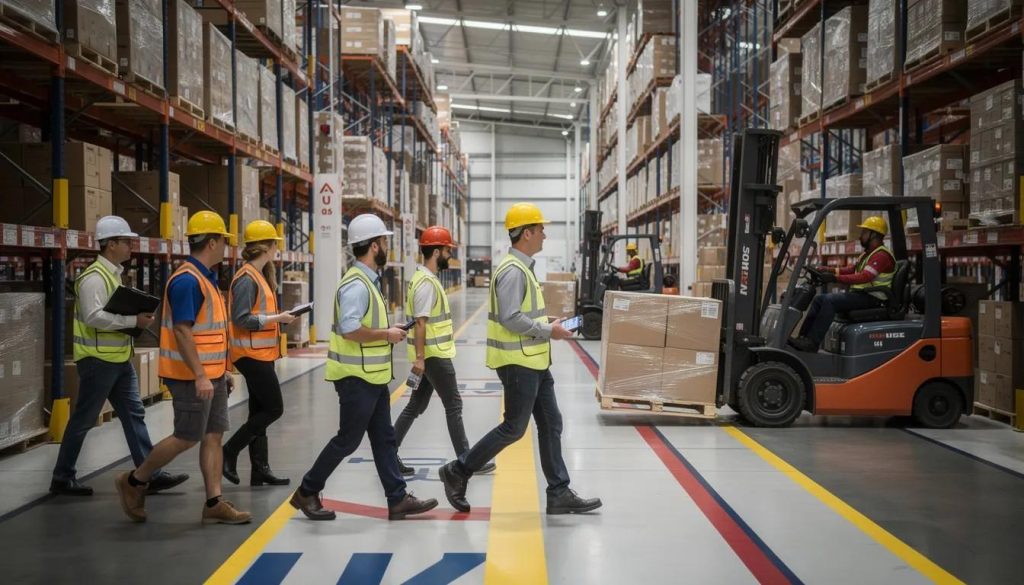
Ensure the Consistency and Workflow Integration
Consistency in design, colour, and numbering is essential for an organised warehouse. Sequential aisle and bay numbering, aligned with your warehouse management system, reduces confusion and improves picking efficiency.
Using the same fonts, colours, and signage style in warehouse signs placed throughout your facility allows staff to intuitively understand and follow instructions, reducing errors and training time. Integrating signs with operational workflows, such as clearly marked quarantine areas or returns zones, supports inventory management and ensures that staff follow the correct processes consistently.
Arrange Proper Placement and Maintenance
Even the best-designed warehouse signs are ineffective if placed incorrectly. Strategic placement considers traffic flow, employee sightlines, and the likelihood of the sign being noticed and followed.
It is important to use secure methods to hang signs, especially large signs, using appropriate materials such as steel cables to ensure safety and visibility. The vertical drop sign-hanging system is ideal for hanging location signs and is both inexpensive and quick to install. Additionally, the rail sign system is widely used in warehouses for clear and effective signage. Signs should avoid overcrowding while remaining highly visible, and their positioning should guide both pedestrians and vehicles safely through the warehouse.
Maintenance is also critical; signs must be regularly reviewed and replaced when faded, damaged, or outdated to prevent confusion and maintain a professional, compliant appearance. At Msigns, we provide guidance on both initial placement and ongoing maintenance, ensuring your warehouse signs continue to perform effectively as your facility evolves.
Key Features for Effective Warehouse Signs
Choosing effective warehouse signage requires attention to visibility, consistency and durability. There is a wide range of warehouse signage options available to suit different needs, from safety signs to organizational labels. Effective warehouse signs should ensure all safety and operational needs are covered. These practical design tips will help you get it right.
Language and pictograms
- Use simple, direct language that all workers can understand regardless of first language
- Rely on standard pictograms from ISO 7010 for universal comprehension
- Avoid jargon or abbreviations that might confuse new staff
Colour codes
Safety signs follow established colour conventions:
| Colour | Meaning | Example |
| Blue | Mandatory action | “Safety footwear must be worn” |
| Red | Prohibition / Fire equipment | “No smoking” / Fire extinguisher signs |
| Yellow | Warning / Caution | “Caution – Forklift trucks operating” |
| Green | Emergency / Safe condition | Fire exit, first-aid point |
Using various colours consistently helps workers recognise sign types instantly without reading text.
Visibility and sizing
- Text should be readable at the distance from which workers approach. As a guide, 1.6-inch high lettering provides visibility from approximately 40 feet.
- Use strong colour contrast—black on yellow for warnings, white on red for prohibitions
- Position signs at eye level where possible, or use hanging signs for visibility across open warehouse space
Consistency
- Number aisles and bays sequentially (e.g., Aisle 01 to Aisle 20, Bay 01 to Bay 30)
- Match numbering systems to your warehouse management software
- Use the same fonts, sizes and materials throughout to create a unified system
Durability considerations
- Choose durable materials that withstand forklift impacts, dust and moisture
- Use reflective or photoluminescent signs in low-light areas
- Install anti-slip floor graphics in pedestrian routes
- Select weather-resistant materials for external yard and loading bay signs
Accessibility
- Position signs at appropriate heights for all workers
- Avoid visual clutter that overwhelms rather than informs
- Consider language barriers by emphasising pictograms over text
- Ensure signs don’t obstruct walkways or create trip hazards
Documentation
- Record significant changes to signage or traffic routes in risk assessments
- Communicate updates during toolbox talks or formal training sessions
- Photograph new installations for compliance records
Implementing and Maintaining a Warehouse Signage System
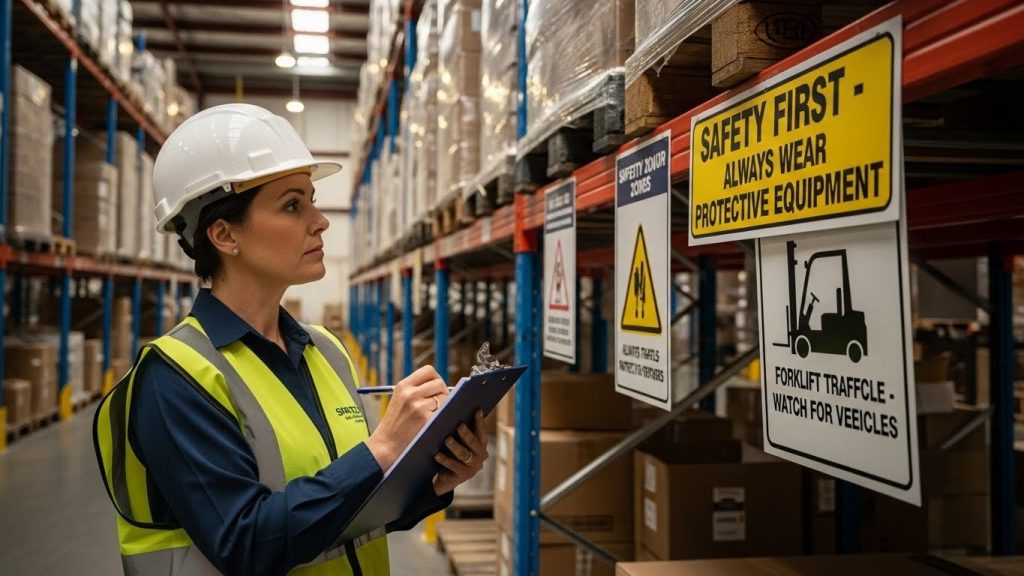
Installing warehouse signs isn’t a one-time task. A systematic approach ensures your signage remains effective as your operation evolves.
Step-by-step implementation
- Audit current warehouse signs: Walk the entire site and document existing signage, noting gaps, damage and inconsistencies
- Map key routes and hazards: Identify all traffic routes, pedestrian walkways, hazardous areas and emergency exits
- Plan a consistent scheme: Design a numbering system, select materials, and create a signage specification document
- Install signs: Work methodically through the warehouse, ensuring correct positioning and secure fixtures
- Review and update: Schedule regular reviews (quarterly or after layout changes) to maintain accuracy
Involving your team
Consult supervisors, forklift drivers and pickers when identifying where signs are missing, confusing or routinely ignored. Workers on the ground often spot issues that desk-based audits miss. Engagement improves compliance—staff are more likely to follow signs they helped create. You can also introduce digital warehouse signs for better visibility.
Maintaining a signage register
Keep a register or plan documenting all warehouse signs, their locations and installation dates. Track changes so you can review after incidents, near-misses or layout modifications. Include photographs for reference during investigations
Removing outdated signs
Old or conflicting signs should be removed promptly. Outdated information creates confusion and can undermine your position in accident investigations. When layouts change, update signage immediately rather than leaving temporary arrangements in place
Linking signage to training
Staff inductions should explicitly cover key warehouse signs, traffic routes and emergency signage. Don’t rely solely on generic health and safety slides—make signage training site-specific. Refresher training after significant changes ensures everyone understands new arrangements
Consistency across multiple sites
Businesses with warehouses in Manchester, Birmingham, London or elsewhere should aim for consistent signage schemes. Staff moving between sites need familiar systems to work safely. Standardisation also simplifies procurement and reduces costs through bulk ordering
Enhance Your Warehouse Safety and Efficiency Today
Choosing the right warehouse signs is an essential step toward creating a safer, more organised, and highly efficient facility.
At Msigns, we specialise in crafting custom outdoor and indoor signage solutions tailored to your warehouse layout, operational needs, and safety requirements. From durable aisle markers and hazard warnings to emergency and wayfinding signs, our expert team ensures that every sign contributes to a clear, consistent, and professional environment.
Contact us to elevate your warehouse operations, reduce risks, and improve staff productivity with expertly designed warehouse signs from Msigns, your trusted partner in industrial signage solutions.