Failing to install compliant fire exit signage can lead to fines, legal action, and more importantly, serious risk to life during an emergency. Yet many UK businesses still get signage placement and fire exit signage regulations in the UK wrong.
Properly installed and maintained fire exit signs not only ensure the safety of staff, visitors, and customers during an emergency, but also help businesses comply with legal requirements under the Regulatory Reform (Fire Safety) and related standards such as BS EN ISO 7010.
This guide by Msigns breaks down everything you need to know about fire exit signage regulations, including the types of signs, correct placement, materials, and maintenance practices. It also explains how to map evacuation routes, designate assembly points, and integrate signage into comprehensive emergency procedures. By following these guidelines, UK businesses can create a safer environment, reduce risks, and demonstrate compliance with statutory obligations.
Whether you’re installing new signs or reviewing existing fire safety measures, this guide provides practical insights and expert recommendations to ensure your premises meet the highest safety standards.
Purpose of the Fire Exit Signage
Fire exit signage is a critical component of any fire safety strategy. The purpose of fire exit signs is to clearly indicate escape routes and exits, ensuring that building occupants can evacuate quickly and safely in the event of a fire or other emergency. Fire exit signs are designed to clearly show people the right place to go upon hearing alarms for a fire or other emergency, with arrows playing a key role in guiding occupants toward the nearest exit. Effective signage reduces panic and confusion, particularly in large or complex buildings.
The primary purpose of fire exit signage is to guide people toward a safe exit. They must be easily visible, clearly understood, and illuminated or photoluminescent so that they can be seen even in low-light or smoky conditions. Signs typically include arrows or pictograms, using standardised symbols from BS EN ISO 7010, which are widely recognised across the UK and Europe. A sign with a running man symbol and an arrow is a particularly useful aid to understanding what to do when a fire alarm sounds.
Core Fire Safety Obligations for Businesses
Under UK law, all businesses, including commercial premises, have specific responsibilities regarding fire safety, including:
- Conducting a fire risk assessment to identify hazards and risks.
- Implementing fire prevention measures, including fire exit routes and signage.
- Providing adequate training to staff on fire evacuation procedures.
- Maintaining all fire safety equipment and signs in good working order.
These obligations are enforced through the Regulatory Reform (Fire Safety) Order 2005, which applies to virtually all non-domestic premises in the UK.
Legal Requirements for Fire Exit Signs and Fire Safety
Compliance with UK fire safety law is not optional. Businesses must ensure their premises meet all legal requirements for fire exit signs and fire safety measures. Failure to comply can result in enforcement action by the local Fire and Rescue Service, fines, and increased risk of injury during emergencies.
BS EN ISO 7010 Compliance
All fire exit signage in the UK should comply with BS EN ISO 7010, the international standard for safety signs. This standard ensures that symbols are consistent, recognisable, and easy to understand, even by individuals who do not speak English. For example, the standardised running-man pictogram and directional arrows indicate the safest route to exit a building.
Using ISO-compliant signage not only enhances safety but also ensures that your business fire safety meets legal obligations. Signs should be visible from a reasonable distance, illuminated where necessary, and maintained to remain legible at all times.
Regulatory Reform (Fire Safety) Order 2005
The Regulatory Reform (Fire Safety) Order 2005 (RRO) is the principal legislation governing fire safety in UK non-domestic premises. Under this order, responsible persons—typically employers, building owners, or facilities managers—must:
- Conduct a comprehensive fire risk assessment.
- Install and maintain adequate fire exit signage.
- Ensure that fire escape routes are unobstructed and clearly marked.
- Provide staff with fire safety information and training.
The order applies to a wide range of premises, including offices, retail spaces, warehouses, and public buildings. Regular audits and reviews are recommended to maintain compliance and adapt to any changes in occupancy or layout.
Health and Safety (Safety Signs and Signals) Regulations
The Health and Safety (Safety Signs and Signals) Regulations 1996 further reinforce the requirement for clear fire exit signage. These regulations specify that signs must:
- Be placed where there is a significant risk that cannot be mitigated by other means.
- Use recognisable symbols and colours as defined in ISO 7010.
- Be maintained in good condition, ensuring legibility and visibility.
Failure to adhere to these regulations can result in legal penalties and undermine your overall fire safety strategy. Implementing compliant signage helps protect employees, visitors, and the reputation of your business.
Who Needs Fire Exit Signage?
Fire exit signs are required in all non-domestic properties and multi-occupancy residential buildings. They are particularly important where occupants may not be familiar with the layout or where escape routes are not immediately obvious. Clear and properly placed fire exit signage can reduce evacuation times by up to 30% in complex buildings.
Businesses and organisations that typically require fire exit signage include:
- Offices and commercial workplaces
- Retail stores and shopping centres
- Warehouses and industrial facilities
- Schools, colleges, and universities
- Hospitals and healthcare facilities
- Hotels, restaurants, and entertainment venues
- Public buildings and shared spaces
In general, any building where people work, visit, or gather must clearly indicate escape routes using compliant fire exit signage. However, in smaller premises, such as a single-room shop with a clearly visible exit, can be exempted. This should always be determined through a formal fire risk assessment carried out by a professional.
Choosing Fire Exit Sign Types and Materials As Per UK Regulations
Selecting the correct type of fire exit signage is essential for effective fire safety. The type and material of signs influence visibility, durability, and compliance with UK standards. Businesses must consider lighting conditions, internal or external placement, and building layout when specifying fire exit signs.
1. Photoluminescent Exit Signs
Photoluminescent exit signs absorb and store light from artificial or natural sources, then emit a glow in the event of a power failure. They do not require an external power source, making them especially useful in darkness or when lighting fails. Photoluminescent signs glow a bright green in low lighting and will point the right way and be completely clear even in conditions of low visibility. They are ideal as fire exit signage for areas where emergency lighting may not be sufficient or where electricity may be interrupted during a fire.
Benefits include:
- Long-lasting glow without electricity.
- Reliable visibility in smoke-filled or darkened areas.
- Low maintenance costs compared with illuminated alternatives.
- Compliance with BS EN ISO 7010 for safe evacuation.
Photoluminescent signs are commonly used in offices, corridors, stairwells, and industrial premises, especially where natural light or emergency lighting is available for recharging.
2. Illuminated Exit Signs
Illuminated exit signs are powered by electricity, often connected to a building’s emergency lighting system. They are particularly useful in larger commercial spaces or buildings with complex layouts where photoluminescent signs may not provide sufficient brightness.
Benefits include:
- Highly visible in both normal and low-light conditions.
- Can be linked to emergency lighting to ensure continuous illumination during power outages.
- Suitable for areas with high foot traffic or long escape routes.
Illuminated signs are often preferred for multi-floor offices, hospitals, theatres, and public venues where visibility is critical at all times.
Sign Size and Viewing Distance Criteria
Correct sizing is crucial for effective fire exit signage. Signs must be visible from a safe distance, allowing occupants to identify exit routes quickly.
Guidelines:
- Standard sign sizes range from 148x210mm to 210x297mm, depending on the viewing distance.
- Signs in long corridors or large halls may require larger dimensions or multiple placements.
- Viewing distance should be at least 10 times the letter height to ensure legibility under emergency conditions.
Placement of Fire Exit Routes and Exit Signs
Proper placement of fire exit signage is as important as choosing the right type of sign. Poorly positioned signs can create confusion during emergencies, delay evacuation, and compromise safety. UK fire safety regulations emphasise that exit signs should clearly indicate routes to safety and be consistently visible from any point within the premises.
Fire exit signs must be installed at every exit point, including doors and escape windows, according to UK Building Regulation standards.
Mapping Fire Exit Routes
Before installing signs, it is essential to map all fire exit routes throughout the building. This includes:
- Identifying primary and secondary escape routes.
- Marking corridors, staircases, and doorways used during evacuation.
- Highlighting areas with complex layouts or potential obstacles.
When mapping fire exit routes and placing signage, it is important to consider the available space within the building. Proper assessment of space ensures that signage is visible and routes are accessible for safe evacuation.
A clear map ensures that signs are placed strategically, directing occupants safely and efficiently to the nearest exit.
Placement at Changes of Direction
Signs should be positioned at every change of direction along an escape route. In long corridors or multi-level buildings, arrows on exit signs guide people along the correct path. For example:
- At T-junctions or corridor intersections, place directional signs above eye level.
- Ensure arrows clearly indicate whether occupants should turn left, right, or continue straight.
This eliminates uncertainty and reduces the risk of bottlenecks during an evacuation.
Above Final Exit Doors
Every final exit must have a clearly visible sign above the door. These signs signal the completion of an escape route and reassure evacuees that they are leaving the building safely.
- Signs above doors should be illuminated or photoluminescent to remain visible in power outages or smoke-filled environments.
- Ensure that signs are not obstructed by furniture, shelving, or decorations.
Indicating Emergency Exit Directions
Directional arrows are an essential element of fire exit signage. Arrows should:
- Follow ISO 7010 standards.
- Be positioned on all exit signs to indicate the correct route.
- Be updated if any modifications to the building layout occur.
Correct placement of signs ensures that all occupants, including visitors unfamiliar with the building, can evacuate efficiently and safely.
Fire Equipment Signage and Fire Assembly Point
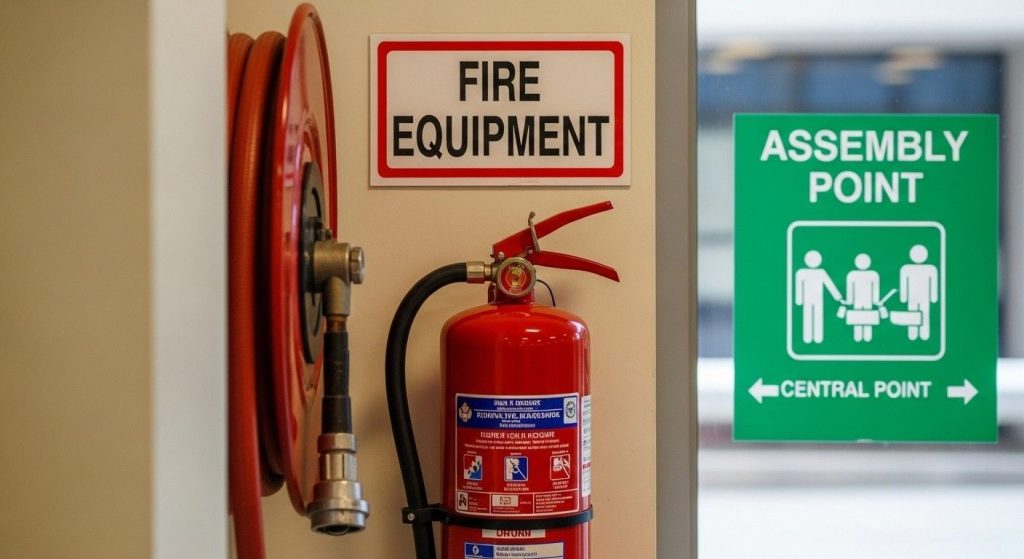
In addition to marking exit routes, businesses must clearly identify fire equipment, such as fire alarm signage, and assembly points. Properly placed fire exit signage signage ensures that occupants and staff can quickly locate fire safety equipment, including fire alarms, and gather safely during an emergency.
Locations Requiring Fire Equipment Signs
Certain areas within a building must display fire equipment signage to indicate the presence of fire safety tools. These include:
- Fire extinguishers: Signs should be mounted above or adjacent to extinguishers for easy identification.
- Hose reels: Clear markings are essential in warehouses, industrial sites, and large commercial buildings.
- Fire alarms and call points: Ensure these are indicated with visible signs so occupants can activate alarms promptly.
Using ISO 7010 standard symbols ensures consistency and recognisability across all fire equipment signage.
Marking Fire Extinguisher and Hose Reel Positions
To enhance visibility and accessibility:
- Fire extinguisher signs should be mounted at eye level, free from obstructions.
- Hose reel signs must clearly indicate the exact location of the equipment, even in low-light or smoky conditions.
- Regular inspections should verify that equipment matches signage placement and is in good working order.
Designating a Fire Assembly Point
A fire assembly point is a predetermined safe area outside the building where occupants gather after evacuation. Properly marked assembly points:
- Facilitate headcounts to ensure everyone has evacuated safely.
- Reduce confusion during an emergency.
- Help fire safety officers or emergency services manage the situation effectively.
Assembly points should be clearly signposted, well-lit, and free from hazards. Directional arrows may be used to guide evacuees from exit points to the assembly location.
Installing and Maintaining Fire Exit Signage
Proper installation and ongoing maintenance are essential to ensure that fire exit signage remains visible, compliant, and effective during emergencies. Poorly installed or neglected signs can fail when needed most, compromising safety and breaching legal obligations.
Professional Fire Safety Signs Installation
While selecting compliant fire exit signage is essential, correct installation is equally important to ensure effectiveness and legal compliance. Professional installation helps ensure that:
- Signs are positioned at the correct height and standard human viewing angle
- Escape routes are clearly and consistently marked throughout the building
- Illumination and visibility requirements are fully met
- Signage aligns with the findings of a fire risk assessment
- All mandatory UK regulations and standards are followed
In larger or more complex premises, a professional approach ensures that signage integrates seamlessly with emergency lighting systems, fire equipment locations, and evacuation procedures. Working with experienced providers can reduce compliance risks, improve safety outcomes, and ensure that your fire exit signage system is fit for purpose.
Testing Illuminated Signs
Illuminated exit signs should be connected to the building’s emergency lighting system and tested regularly:
- Conduct tests during emergency-light checks at least once every six months.
- Verify that all bulbs and wiring function correctly and that signs illuminate evenly.
- Replace any malfunctioning components immediately to maintain compliance with BS EN ISO 7010 standards.
These measures ensure that illuminated signs remain clearly visible even during a power outage.
Photoluminescent Sign Recharging Checks
Photoluminescent exit signs require adequate exposure to light to recharge effectively:
- Inspect signs monthly to ensure they are receiving sufficient natural or artificial light.
- Replace or relocate signs that are permanently shaded or blocked, as this can reduce their glow during an emergency.
- Keep records of inspection dates and any corrective actions taken.
Regular checks guarantee that photoluminescent signs function reliably during blackouts or smoky conditions.
Checklist: Fire Exit Signs, Routes, and Assembly Point
A checklist is an essential tool for ensuring that fire exit signage, routes, and assembly points are properly implemented, maintained, and compliant with UK regulations. By systematically reviewing each element, businesses can reduce risks and maintain a safe environment for staff, visitors, and contractors.
Fire Exit Signage Verification
- Ensure all exit routes are clearly marked with ISO 7010-compliant fire exit signage.
- Confirm visibility of all signs from the full length of corridors and stairwells.
- Check that directional arrows are correctly positioned at every change of direction.
- Verify illuminated and photoluminescent signs are functioning and fully visible.
- Inspect sign condition for damage, fading, or obstruction.
Fire Exit Routes
- Confirm all escape routes are unobstructed at all times.
- Verify that doors open easily without keys or special tools.
- Ensure that all exits lead directly to a safe outdoor area.
- Check that alternative exit routes are clearly marked and accessible.
- Update routes after layout changes, renovations, or new installations.
Fire Assembly Point
- Confirm the assembly point is clearly signposted and visible from all exits.
- Ensure it is safe, free from hazards, and large enough to accommodate all occupants.
- Verify directional signage guides evacuees from exits to the assembly point.
- Conduct headcounts during drills to confirm assembly procedures are effective.
Maintenance and Documentation
- Maintain records of inspections, tests, and maintenance for all fire exit signage and equipment.
- Schedule regular maintenance checks for illuminated and photoluminescent signs.
- Ensure staff training records include evacuation drill participation and awareness of exit routes.
By following this checklist, businesses can systematically verify that fire exit signage, escape routes, and assembly points are compliant, functional, and optimised for safety.
Buying and Specifying Fire Exit Signage for Different Premises
Selecting and procuring the right fire exit signage for your business premises requires careful planning. This ensures compliance, consistency, and safety across all areas of the building.
Creating a Sign Schedule
A sign schedule is a detailed plan listing every fire exit sign required for your premises. It should include:
- Sign type (illuminated, photoluminescent, or standard).
- Size and viewing distance to ensure visibility in all areas.
- Placement location including above doors, at changes of direction, and at assembly points where directional signage is needed.
- Symbol or legend to comply with ISO 7010 standards.
Creating a schedule reduces the risk of omitting critical signs, ensures consistent coverage, and simplifies maintenance planning.
Specifying ISO 7010 Symbols
Using ISO 7010 symbols on fire exit signage ensures that signs are universally recognisable, even to visitors or non-English speakers. Key points to consider:
- Include directional arrows on exit signs where necessary.
- Use pictograms for fire equipment, assembly points, and emergency exits.
- Avoid custom symbols that may confuse staff or visitors.
ISO compliance not only supports legal obligations but also enhances overall safety and clarity.
Bulk Ordering and Consistency
Purchasing signs in bulk ensures uniformity across all premises:
- All exit signs should match in design, colour, and size where possible.
- Standardised signs help occupants and visitors recognise exit routes quickly.
- Bulk ordering reduces costs and simplifies future replacements.
Adding Fire Door and Equipment Signage
Fire safety signage requirements often extend beyond exit routes:
- Install fire door signage where doors must remain closed, including instructions such as “Keep Shut.”
- Add fire equipment signs for extinguishers, hose reels, and alarms to guide staff during emergencies.
- Ensure signs are positioned for maximum visibility and comply with UK fire safety standards.
Meeting Legal Duties and Avoiding Penalties for Fire Exit Signage

Ensuring compliance with fire safety regulations is a legal requirement for all business premises, from small shops to large commercial buildings and public access spaces. Installing fire exit signage and other fire safety signs is mandated by the Regulatory Reform (Fire Safety) Order 2005 and the Health and Safety (Safety Signs and Signals) Regulations 1996. These pieces of legislation set out clear expectations for marking fire exit routes, emergency exits, fire assembly points, and the location of vital fire equipment such as fire extinguishers and alarms.
A thorough fire risk assessment is the foundation of any fire safety strategy. This assessment identifies the necessary fire exit routes, the need for illuminated or glow in the dark fire exit signs, and the best locations for safety signs to ensure every occupant can find the nearest fire exit—even if lighting fails. The assessment also determines where emergency lighting and fire assembly point signs should be installed to support a safe evacuation.
UK verifying standards, such as BS EN ISO 7010, provide detailed guidance on the design, materials, and placement of fire exit signage and other safety signs. Compliance with these standards is essential to avoid penalties and, more importantly, to protect the health and safety of employees, visitors, and residents. In a fire emergency, a few seconds can make all the difference—clear, visible, and correctly installed fire exit signs help ensure everyone can follow the quickest route to safety.
The responsible person for the premises must ensure that all fire exit signs, fire equipment signs, and assembly point signs are installed, maintained, and regularly reviewed. This includes verifying that signs remain visible, legible, and unobstructed, and that any illuminated or glow in the dark signs are functioning as intended. Regular reviews and prompt action to address any issues are vital for ongoing compliance.
Failure to meet these legal duties can result in severe consequences, including substantial fines, prosecution, or even imprisonment. More importantly, non-compliance can compromise the safety of occupants and visitors, putting lives at risk in the event of a fire. By prioritising the installation and maintenance of compliant fire exit signage and safety signs, business premises owners can demonstrate their commitment to fire safety, protect their reputation, and ensure peace of mind for everyone on site.
Ultimately, fire exit signs are a vital part of any fire safety plan. By following the regulations, using the correct materials and illuminated or glow in the dark options where needed, and conducting regular compliance reviews, responsible persons can safeguard their premises and everyone within them—no compromises, just safety.
Common Fire Exit Signage Mistakes to Avoid
Even when businesses install fire exit signage, common mistakes can reduce effectiveness and lead to non-compliance with UK regulations. Some of the most frequent issues include:
- Incorrect placement
Signs positioned too high, too low, or outside the natural line of sight can be easily missed during an emergency. Fire exit signs should be mounted at a height of 1.7m to 2.5m above the floor to maximise visibility. - Missing directional arrows
Failing to include arrows at changes of direction can cause confusion and delay evacuation. Include clear and correct arrows for ease of mobility. - Obstructed or blocked signs
Furniture, shelving, or decorations may partially or fully block visibility. Proper visibility and public access should be the key consideration for the signage. - Non-compliant symbols
Using outdated or non-standard pictograms instead of ISO 7010 symbols can make signs harder to understand. Standard fire exit sign products feature a man running through a doorway and many are accompanied by a directional arrow pointing the way to the nearest exit. - Poor lighting or lack of illumination
Signs that are not illuminated or photoluminescent may not be visible during power failures. Fire exit signs must always be legible in all lighting conditions, so that in the event of a fire the sign is visible through smoke or in darkness. - Failure to update signage after layout changes
Renovations or internal reconfigurations can make existing signage inaccurate or misleading. It is important to update the signage after each layout change.
Avoiding these mistakes is essential to ensure that fire exit signage performs effectively when it is needed most.
Protect Your Premises with High-Quality Fire Exit Signage from Msigns
Ensure your business complies with UK fire safety regulations while enhancing your premises with high-quality fire exit signage from Msigns. We specialise in producing durable, visually impactful signs that not only meet legal standards but also elevate your brand and guide your staff and visitors safely during emergencies.
At Msigns, we combine premium materials, expert design, and UK-wide service to deliver fire exit signage solutions that last. Whether you require photoluminescent signs for low-light areas, illuminated signs for busy commercial spaces, or bespoke layouts for complex premises, our experienced team is here to bring your ideas to life.
Whether you manage a retail store, industrial facility, educational institution, or healthcare setting, our fire exit signage is designed to comply with UK safety standards while enhancing your environment’s professionalism and visibility.
Need help choosing compliant fire exit signage? Contact our experts and get a complete signage plan tailored to your premises.